


Stop Buying Shared Leads: Why Angi and HomeAdvisor Are Destroying Your Painting Business in 2026
Key Insights from This Article:
- The “shared lead” model sells your prospect to 4–7 competitors simultaneously — your close rate tanks before you even pick up the phone.
- The average Angi lead for painting costs $35–$80. You pay win or lose, and so do your competitors.
- Painting contractors who switch to organic SEO report a 3–5× improvement in lead-to-close rates within 90 days.
- A single high-converting website with proper Local SEO can fully replace a $1,500/month Angi subscription within one billing cycle.
- The exit strategy is real: Local SEO + Google Business Profile + content authority is how solo painters scale to 7-figure operations.
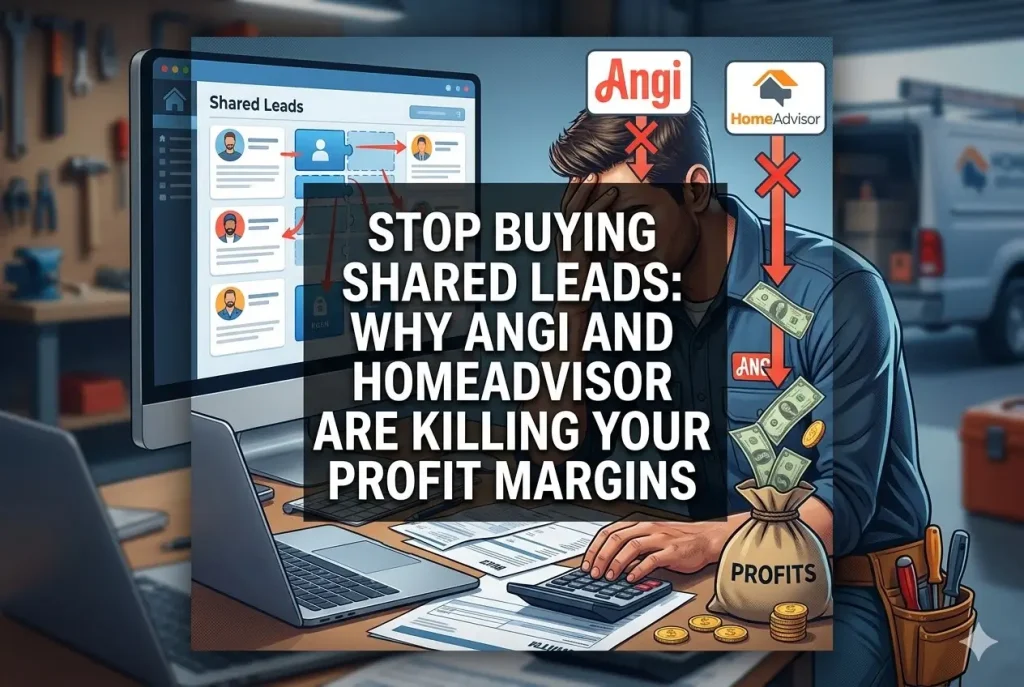
Introduction: You're Not Losing to Better Painters — You're Losing to a Broken System
Let me paint you a picture (no pun intended).
It’s Tuesday morning. You’re on a ladder in Scottsdale or Charlotte or outside Columbus, rollers in hand, when your phone buzzes with a “new lead” notification from Angi. You call within 60 seconds — best practice, right? The homeowner picks up, hears your pitch, and says, “Yeah, I’ve already had three guys call me this morning. I’ll let you know.”
You never hear from them again.
That lead cost you $52. Multiply that by 200 leads a year and you’ve burned over $10,000 to close maybe 15–20 jobs — a fraction of what you need to keep your crew paid, your van insured, and your business growing.
This isn’t bad luck. This is the shared leads trap — and it was designed this way.
In 2026, with Private Equity firms pumping over $31 billion into the Home Services sector, the platforms that once helped small contractors find work are now quietly working against them. This article is your exit ramp. We’re going to break down exactly why shared leads are a margin-killing machine, what the alternative looks like in concrete numbers, and how painting contractors across the US are building exclusive digital lead systems that scale.
The Shared Lead Model: How It Actually Works (And Why It's Stacked Against You)
What "Shared Lead" Really Means
When you sign up for Angi Leads (formerly HomeAdvisor) or Thumbtack’s “Promote” tier, you’re not buying a customer — you’re buying access to a prospect who just submitted a form. That same form triggers notifications to every contractor in your category and ZIP code who is currently active on the platform.
The platform’s business model is simple: they make money whether you close the job or not. You pay per lead. Your competitor pays per lead. Everyone pays. Nobody is guaranteed anything.
Here’s the math that most contractors ignore until it’s too late:
- Average cost per shared lead (painting): $35–$80 depending on job type and market
- Average close rate on shared leads: 8–14% (versus 35–55% on exclusive inbound leads)
- Number of competitors receiving the same lead: 4–7 in major metro markets
- Average time before the homeowner stops responding: under 4 hours
So if you’re paying $50 per lead and closing 10%, you’re spending $500 in lead costs for every single job you book. On a $1,800 interior repaint, that’s 28% of your revenue gone before you’ve touched a brush.
The "Lead Quality" Complaint Is Getting Worse, Not Better
Contractors aren’t staying quiet about this anymore. Multiple class-action and arbitration claims have been filed against Angi/HomeAdvisor alleging the sale of fake, fabricated, or duplicate leads. The FTC has received thousands of complaints. In contractor Facebook groups like “Painting Contractors USA” and “The Painter’s Roundtable,” the sentiment is consistent: the leads got worse when the platform rebranded.
The reason? As Angi/IAC expanded its network through acquisitions and private equity backing, the volume pressure increased. More leads = more revenue. Quality controls became secondary to throughput. You’re not paranoid — the leads did get worse.
The Real Cost of Shared Leads: A Full Profit & Loss Breakdown
Running the Numbers on a "Typical" Angi Month
Let’s say you’re a contractor doing residential repaints in a mid-size metro. Here’s what a realistic Angi spend looks like:
| Metric | Angi / HomeAdvisor | Organic SEO (Month 4+) |
|---|---|---|
| Monthly spend | $800–$1,500 | $300–$600/mo (SEO retainer) |
| Leads received | 20–35 | 12–25 (exclusive) |
| Close rate | 8–14% | 35–55% |
| Jobs booked | 3–5 | 5–12 |
| Avg. job value | $1,400–$2,200 | $1,800–$4,500 (higher intent) |
| Cost per acquired job | $250–$500 | $40–$120 |
| Lead exclusivity | ❌ Shared with 4–7 competitors | ✅ 100% exclusive to you |
The numbers are stark. Organic leads convert at 3–5× the rate of shared leads because the prospect chose you specifically. They Googled “interior painters near me,” saw your Google Business Profile at the top of the Map Pack, read your reviews, visited your site, and called. There’s zero competitive pressure at that moment. You’re not racing three other guys to the phone.
The "But I Need Leads NOW" Objection
This is the most common pushback, and it’s legitimate. If your pipeline is dry today, you can’t wait 6 months for SEO to kick in. Here’s the honest answer:
Use Angi/HomeAdvisor as a short-term bridge while building your organic system — but cap your spend at $400–$600/month and treat it like a loss-leader, not a growth strategy. Meanwhile, invest in your Google Business Profile optimization starting week one, because GBP improvements can generate calls within 30–60 days.
The Organic Alternative: How Painting Contractors Build Exclusive Lead Machines
Pillar 1 — Your Website as a Digital Asset, Not a Digital Brochure
Most painting contractor websites are digital graveyards. A logo, a phone number, five stock photos of a roller on a wall, and a contact form. Zero page authority. Zero local relevance signals. Zero conversion architecture.
A properly built painting contractor website in 2026 uses Silo Architecture — a structured internal linking system that groups related content together and tells Google exactly what services you offer, in what cities, at what price points. Think of it as building separate “authority towers” for:
- Residential Interior Painting (city pages, room-type pages, color consultation pages)
- Exterior Painting (substrate pages: vinyl, stucco, brick, Hardie board)
- Cabinet Refinishing ($2,000–$6,000 per job — your highest-margin ticket item)
- Commercial Painting (offices, HOA communities, multifamily)
- Specialty Finishes (epoxy floors, limewash, Venetian plaster)
Each silo targets different buyer intent. A homeowner searching “cost to repaint kitchen cabinets Charlotte NC” is far closer to buying than someone searching “house painters near me.” Your content should capture both — but the former will close faster.
The ROI reality: A well-built contractor website costs $1,200–$2,500. A single commercial painting contract — an office complex, a school, a multi-unit HOA — can be worth $15,000–$80,000. The math writes itself.
Pillar 2 — Google Business Profile: Your #1 Free Lead Source
If you have a physical service area and you’re not actively managing your GBP, you’re leaving the most valuable free real estate in local marketing untouched.
The Map Pack — the three business listings that appear at the top of Google local search results — receives 44% of all clicks on the search results page. Ranking in the Map Pack for “painters [your city]” is the single highest-ROI action a contractor can take in 2026.
The GBP optimization checklist that actually moves the needle:
- Category accuracy: “Painter” as primary, “House Painter” and “Commercial Painter” as secondary
- Service area configuration: Set 15–20 ZIP codes, not just your city
- Photo volume: 50+ real job photos (use CompanyCam to auto-sync job photos directly to your GBP)
- Review velocity: Aim for 2–4 new reviews per month consistently
- Google Posts: Weekly posts using keyword-rich descriptions (“Interior painting in [city] — 2-day turnaround on 3-bed homes…”)
- Q&A section: Pre-populate 8–10 questions with keyword-rich answers
Common suspension triggers to avoid: using a P.O. Box as your address, using a virtual office address, keyword-stuffing your business name (e.g., “John’s Best Affordable Painting LLC” → instant flag).
Pillar 3 — Local SEO: Dominating the "Near Me" Searches That Matter
Local SEO for painters isn’t just about your website. Google cross-references your business information across dozens of data sources to determine how trustworthy and legitimate you are. This is called citation consistency, and it’s one of the most underrated ranking factors in local search.
Your NAP (Name, Address, Phone) must be identical across:
- Google Business Profile
- Yelp, Facebook, BBB, Houzz, Nextdoor
- Industry directories (PaintingContractors.com, PDCA directory)
- Your website’s footer and Contact page
- Local Chamber of Commerce listings
A single mismatched address format (“St.” vs “Street”) across 40+ citations can quietly suppress your Map Pack rankings for months. Tools like BrightLocal ($29–$49/month) allow you to audit and fix citation inconsistencies at scale without hiring a VA.
The DIY Route: BrightLocal’s Citation Builder is genuinely one of the best tools on the market for contractors managing their own SEO. For a step-by-step audit, Whitespark’s local citation finder is another excellent option. Both have contractor-friendly interfaces.
The Done-For-You Route: At PainterWebLab, our Local SEO team conducts a complete citation audit and cleanup as part of onboarding, then manages your ongoing digital footprint so your Map Pack rankings compound month over month — while you run your crews.
Scaling Beyond Residential: The Commercial Painting Escape Hatch
One of the best-kept secrets in this industry is that commercial contracts virtually eliminate winter seasonality. While residential painting drops 40–60% in the colder months in most US markets, commercial clients — property management companies, HOAs, school districts, hospital networks — operate on annual maintenance schedules with multi-year renewal options.
How to Position for Commercial Work Online
Commercial painting clients don’t browse Angi. They don’t ask neighbors on Nextdoor. They Google things like:
- “commercial painting contractors [city] licensed bonded”
- “HOA exterior painting company [county]”
- “office building interior painting [metro area]”
These are low-competition, high-intent queries. A dedicated commercial painting service page — optimized with the right schema markup, backlinks from local business directories, and a portfolio of completed commercial projects — can rank on page one within 60–90 days in most mid-size US markets.
The sales process is different, too. You’ll need:
- General Liability Insurance ($1M minimum, preferably $2M aggregate)
- Workers’ Comp — non-negotiable for commercial accounts
- A professional digital estimate/proposal system (this is where PaintScout earns its $59/month fee — it generates branded, itemized proposals that look like they came from a $5M operation)
The Technology Stack That Replaces Your Dependence on Lead Aggregators
You can’t scale a painting business on a legal pad and a cell phone in 2026. The contractors winning at 7-figures are running lean, systemized operations. Here’s the stack that actually works:
| Category | Tool | Monthly Cost | Primary Use |
|---|---|---|---|
| CRM / Job Management | QuoteIQ | $49–$99 | Best value CRM for painting contractors in 2026 — estimates, invoicing, scheduling |
| CRM / Job Management | Jobber | $69–$169 | Full field service management — great for crews of 3+ |
| Estimating | PaintScout | $59–$119 | Branded proposals with line-item breakdown; dramatically increases acceptance rate |
| Job Documentation | CompanyCam | $19–$49 | Before/after photos organized by job; feeds GBP and website automatically |
| SEO Research | Semrush | $139 (or $10 trial) | Keyword research, competitor gap analysis, local ranking tracking |
| Local SEO / Citations | BrightLocal | $29–$49 | Citation audit, GBP rank tracking, review management |
The total cost of this stack: under $400/month. Compare that to $1,200+ on Angi with a 10% close rate, and the math is obvious.
OSHA, EPA, and the Compliance Edge That Most Contractors Ignore
Here’s an angle that’s almost never discussed in marketing circles but matters enormously for winning high-value jobs: regulatory compliance is a trust signal.
Commercial clients — property managers, school districts, facility directors — are not just buying paint and labor. They’re buying risk mitigation. They need a contractor who:
- Is registered with the EPA’s Renovation, Repair and Painting (RRP) Rule if working on pre-1978 homes (lead paint compliance)
- Carries proper Workers’ Comp to protect the client from liability
- Follows OSHA 1926 Subpart D fall protection standards for exterior work above 6 feet
- Is licensed in states that require it (CA, FL, TX, NY, NJ — check your state licensing board)
Your website should explicitly display all of this. Your GBP description should mention it. Your proposals should include it. Contractors who make compliance visible on their digital presence consistently win bids over competitors who don’t — even when their price is slightly higher.
This is the authority signal that separates a $150K/year solo operation from a $700K company with commercial accounts on retainer.
Frequently Asked Questions
How much does a painting lead cost on Angi in 2026?
Angi lead prices vary by job type and geography, but painting leads typically run $35–$80 per lead for residential work and $80–$150+ for commercial requests. Critically, you pay for every lead regardless of whether the prospect responds or you close the job. In competitive markets, 4–7 contractors receive the same lead simultaneously, making your effective cost per booked job $250–$500 or more.
Is there a way to get painting leads without paying per lead?
Yes — organic leads through Google. A properly optimized Google Business Profile combined with a well-built website targeting local search queries delivers exclusive inbound leads at zero cost per lead after the initial investment in SEO. Contractors who rank in the Map Pack for “painters [city]” report receiving 8–20 inbound calls per month from that channel alone within 3–6 months of optimization.
How long does it take for Local SEO to start generating painting leads?
Google Business Profile optimizations typically show measurable improvement in impressions and calls within 30–60 days. Website SEO rankings for competitive terms take 90–180 days in most mid-size markets. The timeline shortens significantly with consistent review acquisition, regular Google Posts, and proper citation cleanup. The payoff is cumulative — unlike paid leads, organic rankings compound over time.
What's the best CRM for a painting contractor just starting out?
For solo painters and small crews (1–3 trucks), QuoteIQ is the best value option in 2026 — purpose-built for painting contractors with fast estimating, simple scheduling, and invoicing in one platform at under $100/month. For contractors scaling past $500K in annual revenue with larger crews, Jobber or Housecall Pro offer more advanced route optimization and team management features.
Can I rank in the Map Pack if I work out of my home and don't have a commercial address?
Yes, but you must configure your GBP as a Service Area Business (SAB) and hide your home address. Using a P.O. Box or virtual office address as your listed address violates Google’s guidelines and will get your profile suspended. Set your service areas by city or ZIP code. A home-based SAB can absolutely rank in the Map Pack — Google’s local algorithm rewards relevance and review authority more than physical location in most service-area markets.
How do I get more Google reviews for my painting business?
The most effective method is a post-job text message sequence sent within 24 hours of project completion. Tools like Jobber or QuoteIQ can automate this. The message should include a direct link to your Google review page (generate this from your GBP dashboard). Contractors who text the review request within 24 hours of job completion report 40–60% conversion rates. In-person asking at the punch-list walkthrough adds another 15–20% on top of that.
What's the difference between Angi Leads and Angi Ads?
Angi Leads (formerly HomeAdvisor Pro Leads) is the pay-per-lead model where you pay for each contact, shared with multiple contractors. Angi Ads is a separate program where you pay for a featured placement on the platform — more similar to Google Ads. Both feed the same homeowner audience, but Angi Ads gives you a profile listing rather than direct lead distribution. Neither model delivers exclusive leads; both are fundamentally pay-to-play within a platform you don’t own.
Should I run Google Ads while building my SEO?
Google Ads can be a smart short-term bridge while your organic rankings develop, but only with tight campaign parameters. Broad match keywords like “painters” will burn your budget in hours. Run Exact Match keywords only: “[city] interior painters,” “[city] exterior house painting,” “cabinet painters [city].” Set tight geographic radius (10–15 miles max), run only during business hours, and use call-only campaigns for the highest-intent mobile traffic. Budget $500–$800/month minimum for meaningful data. Pause Angi before scaling Google Ads — don’t run both simultaneously.
How much should a painting contractor spend on marketing?
The industry benchmark for service businesses is 5–10% of gross revenue reinvested in marketing. For a contractor doing $300K/year, that’s $15,000–$30,000 annually — roughly $1,250–$2,500/month. Most contractors dramatically underspend on marketing, then make up for it by overpaying on lead aggregators at suboptimal returns. A properly allocated budget weighted toward SEO, GBP management, and a high-converting website will outperform any aggregator spend at the same investment level.
What should my gross profit margin be as a painting contractor?
Healthy painting contractor gross margins (revenue minus direct job costs — labor, materials like Sherwin-Williams Duration or Benjamin Moore Aura, equipment depreciation) run 40–55%. If your gross margin is below 35%, you likely have a pricing problem, a materials cost problem, or both. Use PaintScout’s estimating templates to build proper markup into every estimate. COGS for paint alone should not exceed 8–12% of job revenue on premium residential work.
Why Painting Contractors Are Winning Without Angi in 2026
The contractors seeing the fastest growth right now share one common trait: they stopped renting audiences from aggregators and started owning their digital real estate.
The shift is straightforward in principle:
- Own your Google rankings → exclusive leads
- Own your GBP → calls from the Map Pack
- Own your reviews → social proof that closes at 3× the rate of cold leads
- Own your content → authority that compounds for years
None of this requires a massive marketing budget. It requires a smart system, the right tools, and 60–90 days of consistent execution.
The contractors still dependent on Angi in 2026 are subsidizing their competitors’ growth. Every $1,200/month Angi subscription is $1,200 that could be building a permanent, exclusive lead asset. The question isn’t whether organic SEO works — the data is unambiguous. The question is when you’re ready to make the switch.
Conclusion: Time to Stop Renting and Start Owning
Shared leads are a short-term fix with a long-term cost. They teach your business to survive on a treadmill — always spending, always competing, never building equity. Every dollar you pour into Angi or HomeAdvisor evaporates the moment you stop paying.
Organic SEO, a properly built website, and an optimized Google Business Profile are assets — they generate value while you sleep, compound over time, and belong to you entirely.
The painting contractors doing $500K, $1M, $2M+ in annual revenue in 2026 are not buying shared leads. They built systems. They own their Google rankings. They get calls from homeowners who already trust them before the conversation starts.
That’s the business you’re building. The exit from the shared-leads trap starts with one decision.
→ Book a free Growth Audit at painterweblab.com and let’s map out exactly what it takes to replace your Angi spend with exclusive organic leads — in 90 days or less.