


Cabinet Refinishing Marketing: How Smart Painters Are Booking $4,000 Jobs While Everyone Else Races to the Bottom in 2026
- Cabinet refinishing projects average $2,000–$6,000 — 3–5× the margin of a standard interior repaint
- Sending traffic to your general homepage kills conversion — a dedicated landing page is non-negotiable
- Facebook carousel ads showing Before → Process → After are the highest-ROI creative format for this service
- Lower competition than residential repaints means faster Map Pack rankings for cabinet-specific keywords
- Done right, one cabinet refinishing crew can generate $15,000–$25,000/month in recurring revenue
The Quiet Gold Mine That Most Painters Are Walking Past
Let’s be brutally honest about what the residential painting market looks like in 2026.
You’re bidding $1,800 for an interior repaint — and so are four other guys from Angi who got the same lead you paid $75 for. Your COGS are climbing because Sherwin-Williams raised prices again. You’re doing takeoffs on Saturday nights, and your net margin, after labor and materials, is hovering somewhere between 18–25%. That’s not a business. That’s a stressful job with overhead.
Meanwhile, the same homeowner who balked at your $2,200 interior quote just paid a cabinet refinishing specialist $4,400 to spray her kitchen cabinets. The job took three days. The competitor used an HVLP sprayer, two quarts of Benjamin Moore Advance, and a dedicated landing page that answered every question before the phone even rang.
That contractor didn’t find her on Angi. She found him on Google.
This is the shift happening right now across the US home services market: contractors who move up the value chain — into high-ticket, specialized services like cabinet refinishing — are quietly exiting the race to the bottom while everyone else fights over $40 shared leads.
This guide is your complete playbook for marketing cabinet refinishing in 2026. We’re covering the landing page architecture, the Facebook Ad strategy, the SEO approach, and the exact positioning that turns your painting company from a commodity into a premium specialist. Let’s get into it.
Why Cabinet Refinishing Is the Single Best High-Ticket Add-On for a Painting Contractor Right Now
Before we talk marketing, you need to understand why this service is such a unique opportunity — because the numbers will change how you think about your business.
The Margin Math Is Completely Different
A typical 3-bedroom interior repaint might bill out at $2,000–$2,800. Your material cost (primer, two finish coats of Sherwin-Williams Duration or comparable) runs $300–$450. Labor for two guys over two days: $700–$900. Add in your overhead allocation — fuel, insurance (General Liability + Workers Comp), admin — and you’re netting maybe $500–$650 on the job. That’s a 23–28% net margin on a good day.
Now look at a mid-range kitchen cabinet refinishing job:
- Project value: $3,200–$4,800 (10 uppers, 12 lowers, island)
- Materials: Benjamin Moore Advance (one gallon covers ~250 sq ft), wood filler, 120/220 grit sandpaper, Zinsser shellac primer, masking film — total material cost: $350–$550
- Labor: One skilled sprayer + helper, 2.5–3 days — $900–$1,200
- Net margin on a $3,800 job: $2,050–$2,500, or roughly 54–65%
That’s not a typo. When you specialize and price correctly, cabinet refinishing operates at a margin profile that’s closer to a software company than a trade business. The key words are specialize and price correctly — and both of those start with your marketing.
Competition Is Thin — For Now
Run a Google search for “interior painting [your city]” and you’ll find 15–20 established competitors with hundreds of reviews and years of Map Pack history. Run the same search for “cabinet refinishing [your city]” and you might find 2–3 legitimate competitors — often guys who aren’t even dedicated painters, just kitchen remodelers offering it as an add-on.
This is a first-mover window. Private equity firms (PE) have poured over $31 billion into the home services sector, and their roll-up strategy is accelerating into core painting services. The cabinet refinishing niche hasn’t been fully colonized yet. If you build your SEO infrastructure now — a dedicated landing page, localized content, Google Business Profile optimization around this keyword cluster — you can lock in Map Pack and organic rankings before the big operators wake up.
It Solves Your Seasonality Problem
Exterior painting revenue drops 40–60% in Northern markets between November and February. Interior repaints slow down significantly too — homeowners aren’t redecorating, they’re paying off Christmas debt. But kitchen cabinet refinishing is seasonally resilient. January and February are peak months for kitchen renovation planning. Homeowners stuck inside during winter are staring at their cabinets thinking, “I hate these.” Your January pipeline can be full if your digital presence targets this demand correctly.
The #1 Marketing Mistake Killing Your Cabinet Refinishing Revenue: The Homepage Problem
Here’s the scenario that plays out every day for contractors trying to add cabinet refinishing to their service mix:
They update their homepage to say “We also do Cabinet Refinishing!” They add a photo or two to their gallery. Maybe they run a Facebook ad that sends traffic to the homepage. Inquiries are slow. They conclude that cabinet refinishing “doesn’t work in our market” and go back to chasing $1,800 repaints.
The problem isn’t demand. The problem is conversion architecture.
Your general homepage serves multiple masters: residential exterior, interior, commercial, new construction, deck staining. Its messaging is diluted. A homeowner searching “cabinet refinishing near me” or scrolling Facebook who lands on a generic painting contractor homepage faces immediate cognitive friction: Does this company really specialize in this, or is it just an add-on? They hit the back button. Your bounce rate tanks your Quality Score if you’re running Google Ads. Your cost per lead skyrockets.
What a Dedicated Landing Page Actually Does
A dedicated cabinet refinishing landing page eliminates every distraction and speaks exclusively to the person who wants her cabinets refinished. Here’s what that architecture looks like:
Above the fold: A striking Before/After hero image (ideally a local project in a style relevant to your market — Shaker cabinets in the suburbs, raised-panel in an older neighborhood). A headline that addresses the real pain: “Transform Your Kitchen Without the $30,000 Price Tag of New Cabinets.” A phone number and a “Get Free Estimate” button that are impossible to miss.
The Trust Section: Process breakdown. Homeowners are terrified about dust, overspray, and whether the finish will hold up. Address every objection in sequence:
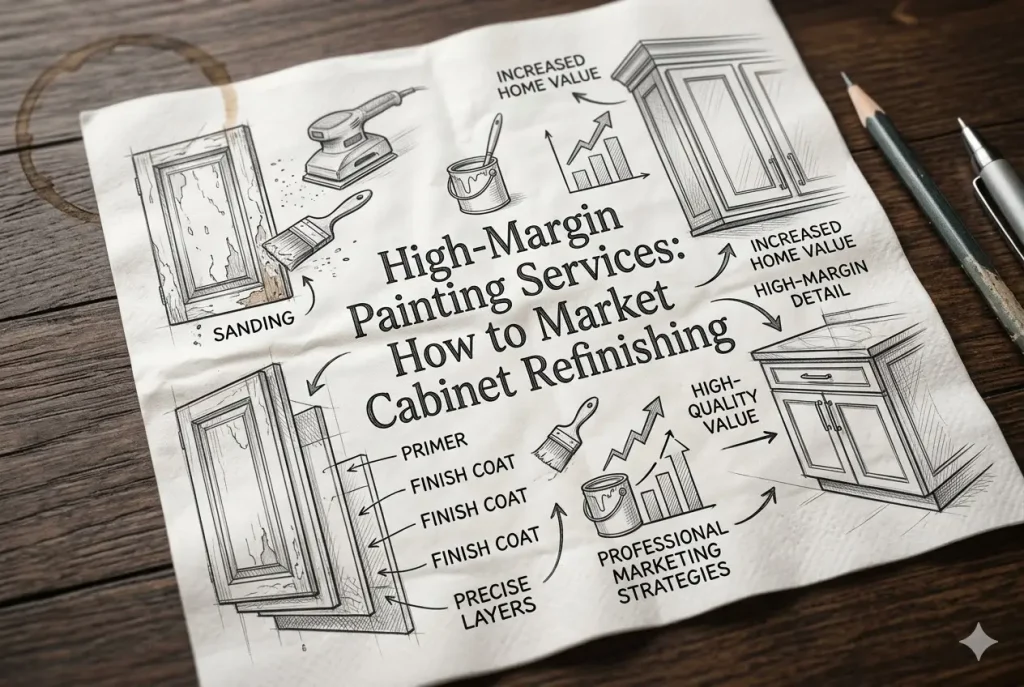
- Day 1: Cabinet door removal, thorough degreasing with TSP substitute, light sanding with 120-grit
- Day 2: Spot-filling, Zinsser BIN shellac primer for superior adhesion on pre-existing finishes
- Day 3: Two topcoats of Benjamin Moore Advance (water-based alkyd — the industry standard for durability), cured to a 5H pencil hardness within 30 days
The Gallery: Not just finished photos. Before, During, and After, in sequence. Show the grimy, dated 1998 oak cabinets. Show the masking film protecting the countertops. Show the sprayer working. Show the stunning after. This sequence builds trust and answers the “how long will it last?” question visually before it’s asked.
Social Proof: Video testimonials from homeowners in your market (CompanyCam integrates directly with your job photos — use it to build these case studies automatically). Written reviews with full names and neighborhoods: “Maria T., Austin TX — ‘We were quoted $28,000 for new cabinets. ProfessionalName did the job for $3,900 and they look better than new.'”
FAQ section: Answer the real questions. “How long does it last?” “Will it chip?” “Can you do painted over stained wood?” “Do you color-match to Benjamin Moore samples?” “Do I need to empty all the cabinets?”
The CTA: One action. One form. First name, phone number, zip code, “How did you find us?” That’s it. Every additional field you add drops conversion 10–15%.
If you’re running a general WordPress site right now and trying to bolt this onto a page, you’re fighting the platform’s architecture. PainterWebLab builds dedicated cabinet refinishing landing pages from the ground up — silo-structured, conversion-optimized, and pre-loaded with a Before/After gallery framework. If you want to see how this is built out for contractors in your market, book a free 30-minute marketing audit at painterweblab.com.
Facebook Ads for Cabinet Refinishing: The Carousel Strategy That Consistently Books Jobs
Google Ads and SEO capture existing demand — people already searching for the service. Facebook Ads create demand — they interrupt people who didn’t know they wanted this service until they saw their neighbor’s results. For cabinet refinishing, Facebook is uniquely powerful because the transformation is so visually dramatic that it stops the scroll.
The format that outperforms everything else in 2026 is the three-image carousel.
Card 1 — The "Before" (Pattern Interrupt)
The first card should be your most jarring Before photo. Dated oak. Orange honey stain. Dirty handles. Small kitchen that looks cramped. The headline overlay: “Your kitchen doesn’t have to look like this anymore.” Do NOT use a clean, beautiful photo as card 1. You need the viewer to feel the pain, not see the solution yet.
Copy below the carousel: “Still living with cabinets from 1997? 70% of homeowners choose cabinet refinishing over replacement — and save $15,000–$25,000 in the process.”
Card 2 — The Process (Build Trust, Neutralize Objections)
This card is your secret weapon against the competitor who shows only polished afters. Show your crew masking countertops and appliances with 3M masking film. Show the HVLP or airless sprayer (Graco X5 or Titan Impact 440 are industry-recognized setups that signal professionalism to the homeowner who’s done any research). Show the multi-step prep — deglossing, sanding, priming.
Headline overlay: “Professional prep = a finish that lasts 10+ years.”
This card builds the E-E-A-T signal that distinguishes you from the $800 brush-and-roll guy who shows up with a bucket of Behr from Home Depot.
Card 3 — The After (The Close)
Now you show the transformation. Crisp white or two-tone (navy island + white perimeter is the 2025–2026 trend), clean hardware, professional reveal photo. Same angle as Card 1 if possible — the side-by-side effect in the viewer’s mind is powerful.
Headline overlay: “Same kitchen. $3,800. Not $32,000.”
CTA button: “Get My Free Cabinet Quote” → directs to your dedicated landing page, not your homepage.
Targeting Parameters That Work in 2026
- Custom Audience: Upload your existing customer list. Run a Lookalike Audience (1–2%) — Facebook/Meta’s algorithm is exceptional at finding homeowners with similar profiles.
- Interest Targeting: Homeowners (checkbox), Home Improvement, Kitchen Renovation, HGTV, Houzz, home equity loan intent signals
- Demographics: Women 35–65 (research consistently shows women drive 80%+ of home improvement purchase decisions for interior projects)
- Geography: 15–20 mile radius from your primary service area. Not broader.
- Budget Entry Point: $20–$35/day per ad set to exit the learning phase. Scale winning ad sets to $75–$100/day after 50+ conversions.
Retargeting: Where Your Profit Lives
Set up a retargeting audience of everyone who visited your cabinet refinishing landing page but didn’t fill out the form. Run a separate ad with a softer CTA — “Still thinking about your kitchen? Here’s what our clients say…” — featuring a video testimonial. Retargeting audiences convert at 3–5× the rate of cold traffic and cost a fraction of the CPL.
SEO Strategy for Cabinet Refinishing: Own Your Local Market
A Facebook ad budget runs out. SEO compounds. Here’s how to build an organic moat around the cabinet refinishing keyword cluster in your market.
Keyword Architecture
Your primary landing page targets: “cabinet refinishing [city]” and “cabinet painting [city]”
Supporting blog content (which feeds authority to the main page via internal links) covers:
- “How long does cabinet refinishing last?” (informational, high-volume)
- “Cabinet refinishing vs replacement: cost comparison [year]”
- “Best paint for kitchen cabinets: contractor’s honest review” (Benjamin Moore Advance vs Sherwin-Williams Emerald Urethane)
- “Cabinet refinishing cost [city] [year]”
- “How to prepare cabinets for painting: professional process”
Each supporting article links back to your landing page with anchor text variations: “cabinet refinishing specialists in [city],” “professional cabinet painters near [city].”
Google Business Profile (GBP) Optimization for Cabinet Services
Most contractors have a GBP with 3–4 service categories: Painting Contractor, House Painter, Interior Painter. Add “Cabinet Painter” and “Cabinet Refinishing Service” as additional categories. In your Services section, create a dedicated Cabinet Refinishing entry with a full description including materials (Benjamin Moore Advance, Sherwin-Williams Emerald Urethane), process, and warranty language.
Upload Before/After project photos weekly — specifically tagged with the service area location in the filename (e.g., cabinet-refinishing-austin-tx-before.jpg). GBP photo activity is a ranking signal that most competitors ignore.
One critical compliance note: Never use a P.O. Box as your GBP address. Google has been aggressively suspending profiles using P.O. Boxes or virtual offices. If you run a service-area business, hide your home address and set your service radius correctly. Getting suspended costs you weeks of ranking recovery.
If managing your GBP profile alongside running crews sounds like one more thing on an impossible list, PainterWebLab’s Local SEO package includes full GBP management — weekly photo posts, Q&A monitoring, review response management, and monthly citation audits. See what’s included here.
Citation Building and NAP Consistency
Your business Name, Address, and Phone number (NAP) must be identical across every directory: Google, Yelp, Angi, Houzz, HomeAdvisor, BBB, Bing Places, Apple Maps, and 40+ niche home service directories. One mismatched address format (“St.” vs “Street”) creates conflicting signals and suppresses local rankings. Use BrightLocal or Whitespark to audit your citation footprint — both offer free trials and are worth every dollar for the time they save.
Pricing Cabinet Refinishing Correctly: Don't Leave $1,200 on the Table
Contractors new to cabinet refinishing consistently underprice because they apply their linear-foot interior painting logic to a completely different job type. Here’s a framework that holds up in most US markets in 2026:
| Cabinet Type | Door Count | Low-End Market Price | Premium Market Price | Material Cost | Target Margin |
|---|---|---|---|---|---|
| Small Kitchen | 14–18 doors | $1,800 | $2,800 | $280–$380 | 52–60% |
| Mid-Size Kitchen | 22–30 doors | $2,800 | $4,800 | $380–$520 | 55–65% |
| Large Kitchen + Island | 35–50 doors | $4,200 | $6,500+ | $550–$750 | 58–68% |
| Two-Tone (Island Contrast) | Any size + $400–$600 | +$400 | +$600 | +$60–$80 | 65%+ |
Rule of thumb: Price per door plus a flat box fee. In 2026, $80–$120 per door (both sides, including prep and two finish coats) is defensible in most suburban US markets if your landing page and reviews establish premium positioning. In high-cost metros (NYC, LA, Seattle, Boston), $140–$180 per door is standard.
Use PaintScout to generate professional, itemized estimates that show the homeowner exactly what they’re getting. Contractors who send a formal proposal PDF — rather than a text message or email number — close at significantly higher rates because they signal professionalism. Cabinet refinishing is a $4,000 decision; the homeowner needs a document that matches that price point.
For tracking jobs, follow-ups, and scheduling your refinishing crew, QuoteIQ is worth a serious look in 2026 — it’s built specifically for the residential contractor workflow, costs a fraction of what Jobber or Housecall Pro charge at scale, and handles the estimate-to-invoice pipeline cleanly. Many contractors start here before graduating to more complex CRMs.
Building Your Portfolio: The CompanyCam System That Sells Jobs While You Sleep
Your portfolio is your silent salesperson. A cabinet refinishing homeowner is doing significant visual research before she calls anyone — Pinterest, Houzz, Instagram, and Google Images are all part of her journey. If your photo documentation is weak, you lose deals to contractors with better content, regardless of your actual quality.
The CompanyCam workflow for every cabinet job:
- Before: Full kitchen angles (straight-on, corner perspective), close-up of one cabinet door showing current condition (grease, chipping, dated finish), handles and hardware detail shots
- During: Degreasing application, sanding (shows process professionalism), masking of countertops and appliances, primer coat going on
- After: Identical angles to your Before shots (critical for direct comparison), hardware reinstalled, cabinet interiors if painted, detail shot of finish quality at edge and corner
CompanyCam automatically geotags and timestamps every photo. Export the project album with one click and embed it directly on your landing page. Your Before/After gallery, which is the single highest-converting element of your cabinet refinishing page, updates itself.
Frequently Asked Questions
How much should I charge for cabinet refinishing in 2026?
In most suburban US markets, pricing ranges from $80–$120 per door (both sides, full prep, prime, and two finish coats). A typical mid-size kitchen with 22–28 doors lands at $2,400–$4,000. In premium metros — New York, Los Angeles, Seattle, Boston — $140–$180 per door is standard. Price for your market’s median home value and always send a formal written proposal via PaintScout or similar, not a text message quote.
What's the best paint for kitchen cabinet refinishing?
The two professional standards in 2026 are Benjamin Moore Advance (water-based alkyd) and Sherwin-Williams Emerald Urethane Trim Enamel. Both cure to a hard, washable film and are specifically engineered for high-use surfaces. Avoid standard latex wall paint — it won’t hold up to kitchen use regardless of how well you prep. A shellac-based primer like Zinsser BIN improves adhesion significantly, especially over previously stained or lacquered cabinets.
How do I find cabinet refinishing clients without paying for Angi leads?
Three channels that work without shared-lead platforms: (1) Facebook carousel ads targeting homeowners in a 15-mile radius — the Before/After format has exceptional CPL for this service; (2) a dedicated cabinet refinishing landing page with local SEO targeting “cabinet refinishing [city]” keywords; (3) partnerships with kitchen designers and real estate agents who regularly need pre-listing refreshes. The last one has zero cost and high close rates since the referral pre-qualifies the lead.
Should I create a separate landing page for cabinet refinishing or add it to my main site?
Always create a dedicated page — ideally a standalone landing page with no navigation menu to distract the visitor. Sending paid ad traffic or SEO traffic to a general painting homepage kills conversion rates because the messaging is diluted. A page focused entirely on cabinet refinishing — covering the process, materials, durability, pricing range, and local Before/After photos — converts at 2–4× the rate of a generic homepage.
How do I rank on Google for "cabinet refinishing near me"?
Start with your Google Business Profile: add “Cabinet Painter” as a category, upload project photos weekly, and create a dedicated Services entry for Cabinet Refinishing with detailed copy. For organic rankings, build a dedicated landing page targeting “[cabinet refinishing] + [city]” and publish supporting content (cost guides, process articles, product comparisons). BrightLocal and Whitespark are the best tools for tracking your local rankings and citation health.
How long does cabinet refinishing take, and what do I tell clients?
A standard mid-size kitchen is a 2.5–3 day job for an experienced sprayer + helper: Day 1 is removal, degreasing, and light sanding; Day 2 is priming and first topcoat; Day 3 is final topcoat and reinstall. Set clear expectations about curing time — Benjamin Moore Advance reaches full hardness in 21–30 days, and clients should be gentle with cabinets during that window. Managing this expectation upfront eliminates callbacks and protects your reviews.
What equipment do I need to start offering cabinet refinishing?
Minimum viable setup: an HVLP sprayer (Fuji Mini-Mite 4 or Graco X5), an oscillating sander (Makita or DeWalt with 120/180/220 grit), a paint booth setup (heavy plastic sheeting and a fan with a furnace filter for overspray control), and masking film for job site protection. Budget $2,500–$4,000 for a proper initial equipment setup. The margin on your first two or three jobs pays back this investment.
Can I do cabinet refinishing in winter when exterior painting is slow?
Yes — this is one of the primary appeals of the service. Cabinet refinishing is entirely indoors and climate-controlled, making it ideal for filling your pipeline from November through February when exterior work and even interior repaints slow down. Many contractors use a dedicated Facebook ad campaign starting in October (“Get your kitchen refreshed for the holidays”) to pre-book their December and January calendar.
How do I handle the objection "I'm just going to buy new cabinets"?
This objection is actually your best friend because it reveals a serious budget comparison. The average cost of new semi-custom cabinets in the US in 2026 is $12,000–$35,000 installed. Your refinishing quote at $3,500–$4,500 gives the homeowner 90% of the visual transformation for 15% of the cost. Address this directly on your landing page with a cost comparison section: “New Cabinets: $18,000–$35,000. Cabinet Refinishing: $2,800–$5,500. Same kitchen, different budget.”
Is EPA RRP certification required for cabinet refinishing jobs?
The EPA’s Renovation, Repair, and Painting (RRP) Rule applies to projects disturbing lead-based paint in pre-1978 housing. If you’re working on cabinets in homes built before 1978, RRP certification is legally required, and violations carry fines up to $37,500 per day per violation. Check with your state licensing board for additional requirements — some states have stricter regulations than federal EPA standards. Certification courses are widely available through the EPA-approved provider network and typically run $200–$400.
Conclusion: Stop Bidding on $1,800 Jobs When $4,000 Jobs Are Sitting Untouched
The cabinet refinishing opportunity in 2026 is real, it’s significant, and it’s available to contractors who execute the marketing correctly. The formula isn’t complicated: a dedicated landing page that answers every question before the phone rings, a three-card Facebook carousel that stops the scroll with an undeniable Before/After transformation, and a local SEO footprint that captures the homeowners who are already searching for exactly what you offer.
The contractors who will dominate this niche over the next 24 months are the ones who act before private equity-backed roll-ups flood the market with ad budgets that small operators can’t match. Your competitive advantage right now is speed, local trust, and real portfolio documentation — assets that take time and can’t be bought overnight.
If you want a dedicated cabinet refinishing landing page built, your Facebook ad creative developed, and your local SEO infrastructure laid in — without spending six months figuring out WordPress silos and Meta Business Manager — that’s exactly what PainterWebLab does for US painting contractors.
Book your free 30-minute Marketing Audit at painterweblab.com — we’ll audit your current web presence, identify the gaps, and give you a specific action plan you can implement whether you work with us or not.